India is becoming one of the world’s most important markets for AI video production — both as a buyer and as a supplier to global brands. The combination of a deep creative-services talent pool, low fixed costs, fluency in 22+ official languages, and a generation of studios that adopted generative tools early has made Indian AI video studios a serious option for marketers worldwide. This is the 2026 industry report: market size, the studios shaping the space, real pricing in INR, sector-by-sector adoption, and what the next 18 months look like.
TL;DR — India’s AI video industry in 2026
- India’s AI video production market is estimated at ₹4,500–6,000 crore (~$540–720M) in 2026, growing 35–45% year on year.
- Indian studios deliver equivalent output at 30–50% lower cost than US/UK studios, with the same global AI tool stack.
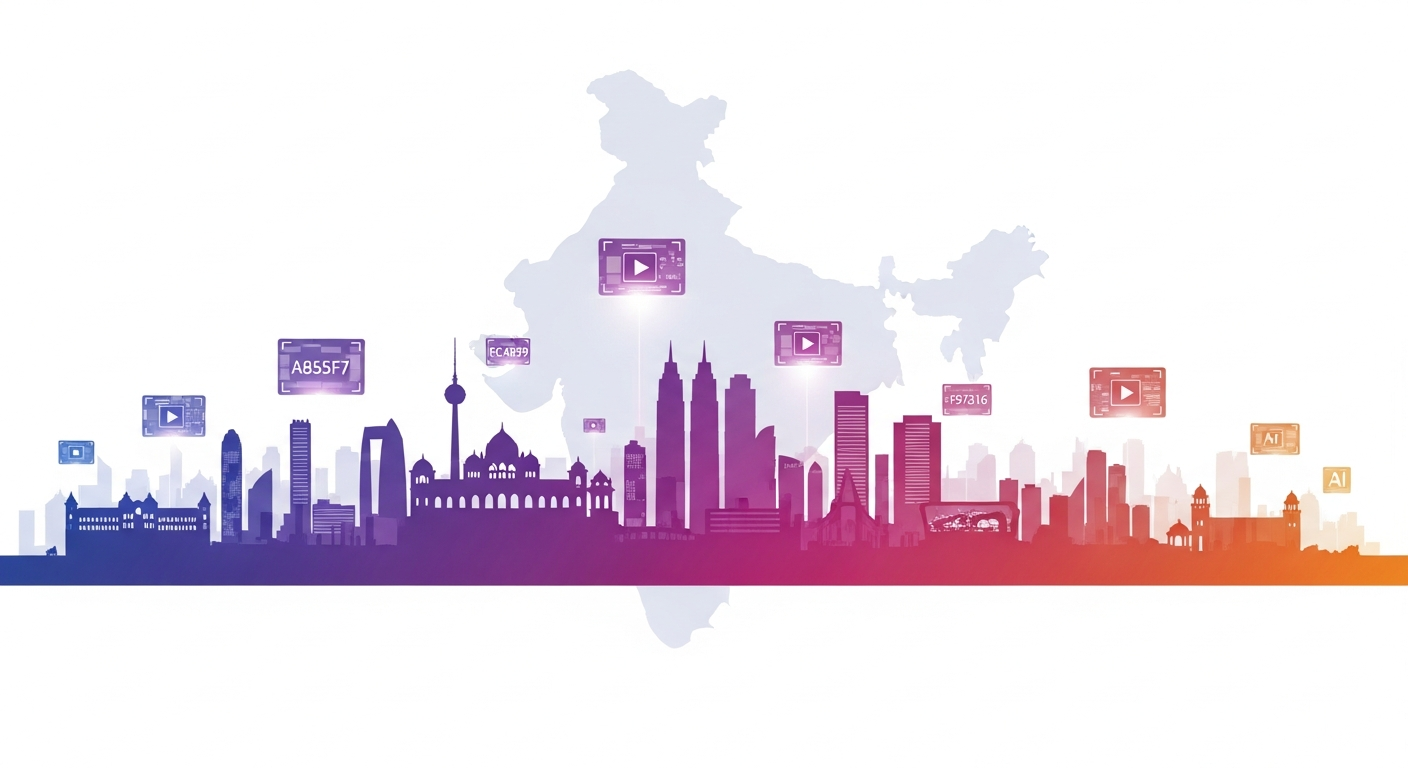
- Three hubs dominate: Mumbai (entertainment), Delhi–NCR / Noida (marketing & corporate), Bengaluru / Hyderabad (SaaS, tech, regional film).
- The biggest accelerant: AI dubbing & voice cloning across 12+ Indian languages, unlocking economically viable multi-language video.
- Adoption is fastest in marketing & social, SaaS explainers, e-commerce, and regional film & OTT.
India’s AI video market size in 2026
Pinning a precise number on the Indian AI video production market is hard — most of the work runs through advertising, marketing, and film budgets that don’t break out the “AI” line. But three triangulated estimates put the 2026 number in a tight range:
- Advertising-led estimate: India’s total digital ad spend is on track for ~₹65,000 crore in 2026. Video accounts for roughly 30–35% of that, of which industry surveys suggest 18–22% now passes through some AI-assisted production. That implies ~₹4,200 crore on the marketing side alone.
- Studio-led estimate: Roughly 600+ studios in India now describe themselves as “AI-first” or “AI-assisted.” Average annual revenue $400K–$1M per studio puts the studio-services market at ~$300–600M.
- Tool-spend estimate: Spending on AI video tooling (subscriptions to Runway, Sora, Veo, ElevenLabs, HeyGen, Synthesia, etc.) by Indian creators and studios is approaching $100M annually, mostly via team subscriptions.
Add the entertainment-industry uptake (regional film, OTT originals, TV serials) on top of the marketing-services and tool-spend numbers, and the total addressable market in India lands at ₹4,500–6,000 crore (~$540–720M) for 2026, with year-on-year growth in the 35–45% band. This is one of the fastest-growing creative-industry sub-segments in India today.
Why India became an AI video hub
The acceleration in India has five compounding drivers, and they don’t exist together in many other countries:
- Existing creative-services depth. India has been the back-office of global VFX and animation for 25 years. The pipeline-thinking and project-management muscle transferred directly to AI video.
- Language & localization advantage. No other market produces commercial video in 12+ languages routinely. Indian studios were already solving multi-language delivery — AI dubbing slotted into existing workflows.
- Cost arbitrage that survived. Even after AI compressed per-unit costs globally, the India delivery premium (skilled producers + editors + creative directors at ~30–50% of US rates) holds. Software tools are priced globally; labor is priced locally.
- Domestic demand at scale. India’s own digital ad market is one of the four largest in the world. Studios got real volume from day one — they didn’t have to scout export clients to survive.
- Talent influx from film & TV. Editors, sound designers, and VFX artists from Mumbai’s film industry moved into AI-first studios fast — bringing craft skills that pure-tech AI studios in other geographies lack.
AI video production cost in India (INR pricing)
The most-asked question from Indian buyers: what does a project actually cost in INR? The table below is what serious AI-first studios across Mumbai, Delhi-NCR, Bengaluru, and Hyderabad were quoting in early 2026:
| Deliverable | India price (INR) | Equivalent global studio price |
|---|---|---|
| 15–30s templated social ad | ₹25,000 – ₹1,20,000 | $300 – $1,500 |
| 30–60s bespoke marketing spot | ₹1,50,000 – ₹6,50,000 | $2,000 – $8,000 |
| 60–90s SaaS / product explainer | ₹2,50,000 – ₹9,00,000 | $3,000 – $12,000 |
| 2–3 min brand film | ₹6,50,000 – ₹20,00,000 | $8,000 – $25,000 |
| 5–15 min documentary / branded film | ₹12,00,000 – ₹40,00,000 | $15,000 – $50,000 |
| Series / TV pilot | ₹40,00,000+ | $50,000+ |
Indian studios pricing in INR generally run 30–50% below US/UK studio quotes for the same brief, with the same underlying AI stack. The savings sit in skilled-labor costs, not in tooling or quality. For the complete cost breakdown and variables, see AI Video Production Cost in 2026: Complete Pricing Breakdown.
The three Indian AI video hubs
Mumbai — entertainment, OTT, brand films
Mumbai’s AI video sector grew straight out of the city’s existing film and TV ecosystem. Studios here are strongest on cinematic brand films, OTT promo content, music videos, and AI-assisted VFX for film and TV serials. Hindi-first, Marathi and Gujarati secondary. The talent pool — directors, editors, sound designers — is the deepest in the country.
Delhi–NCR / Noida — marketing, corporate, B2B
The Delhi–NCR cluster (with Noida and Gurugram) is where marketing-led AI video has its center of gravity. Studios here serve B2B SaaS, e-commerce, banking and financial services, and large corporate clients — work that prioritizes turnaround and volume over cinematic craft. Hindi and English are standard; regional language work runs through partner studios. Vidxen, headquartered in Noida’s Logix Cyber Park (Sector 62), sits in this cluster.
Bengaluru / Hyderabad — SaaS, tech, regional film
South India’s twin hubs have grown around two distinct verticals — Bengaluru for tech and SaaS explainers (driven by the city’s startup density), Hyderabad for AI-assisted production in Telugu and Tamil cinema and OTT. Both cities have strong cross-pollination with Mumbai for VFX work.
Sector-by-sector adoption
| Sector | AI video adoption | Typical use cases |
|---|---|---|
| Performance marketing & D2C | Very high | Variant generation for Meta & Google ads, A/B creative tests, per-language cuts |
| SaaS & B2B tech | Very high | Product explainers, demo videos, sales enablement |
| E-commerce | High | PDP product video at SKU scale, Reels cuts, influencer-style UGC |
| BFSI | Growing | Customer education, compliance-reviewed explainers, multilingual |
| Regional OTT & film | Growing | Pre-viz, VFX, dubbing, virtual sets, de-aging |
| Education & EdTech | High | Course videos in multiple languages, animated explainers |
| Government & public | Emerging | Awareness campaigns, citizen-service explainers |
Indian languages: the moat global studios can’t match
The one capability where Indian AI video studios out-deliver every global competitor is multilingual production. AI dubbing and voice cloning in 2026 covers 12+ Indian languages at near-native quality — Hindi, Tamil, Telugu, Bengali, Marathi, Gujarati, Kannada, Malayalam, Punjabi, Odia, Assamese, and Urdu — plus full per-language script localization (not just translation).
A brand that previously could only afford an English video for the urban audience can now ship the same video in eight Indian languages for ~₹40,000–₹80,000 more in total. That has changed the economics of national campaigns — and is the single biggest reason FMCG, telco, and BFSI marketers in India shifted to AI-first studios in 2025–26.
Working with an India-based AI video studio?
Vidxen is headquartered in Noida and delivers globally. 500+ projects shipped, 150+ clients, 12 Indian languages in scope. Share your brief — we quote in INR or USD, fixed pricing, 24-hour response.
Talent & training
India’s AI video talent pipeline is now feeding from three sources:
- Lateral movement from film, TV, and VFX — editors, sound, motion-graphics artists transitioning into AI-augmented production workflows.
- New AI-focused programs — short courses and post-grad diplomas at MICA, FTII, Whistling Woods, and a growing list of private institutes that introduced AI video production tracks in 2024–25.
- Self-taught creator economy — solo creators and small studios learning on the job through YouTube, Discord communities, and platform marketplaces (Runway Academy, Fiverr Pro).
Policy & regulation
India’s regulatory environment for AI video is still taking shape but the shape is now visible. The IT Rules amendments and the Digital India Bill (in progress through 2025–26) introduce three things every studio and buyer should track:
- Synthetic content labelling. AI-generated or AI-modified media in political, advisory, or commercial contexts must be labelled. Several platforms in India already enforce this through metadata-based detection.
- Deepfake liability. Distribution of non-consensual deepfakes — particularly of women, public figures, or in election contexts — is now explicitly criminal under updated IT Rules.
- Data localization for generation. Some regulated sectors (BFSI, healthcare, government) require AI generation to happen on India-located infrastructure. Several Indian studios now offer on-shore generation pipelines for these clients.
The complete ethics-and-disclosure picture is covered in The Ethics of AI Video Production: Deepfakes, Disclosure & Trust.
The next 18 months
Three trends to watch in India through 2026–27:
- Regional-OTT AI originals. Streaming platforms commissioning AI-assisted originals in Tamil, Telugu, Bengali, and Marathi — economics that didn’t work two years ago now do.
- Export to MENA and Southeast Asia. Indian studios are increasingly selling AI video services to UAE, Saudi Arabia, and Indonesia — markets that share the multilingual challenge but lack a comparable supplier base.
- Consolidation into integrated studios. The fragmented landscape of 600+ studios is starting to consolidate around 20–30 multi-service shops that can run end-to-end pipelines for enterprise clients. Specialization (animation-only, dubbing-only) survives at the edges.
For the parallel view on what AI is doing to Indian entertainment specifically — Bollywood, regional cinema, TV serials — see How AI Is Transforming Indian Film & TV Production in 2026.
FAQ — AI video production in India
How big is the AI video production market in India?
An estimated ₹4,500–6,000 crore (~$540–720M) in 2026, growing 35–45% year on year. The market spans marketing services, film & OTT entertainment, e-commerce, SaaS, and education.
How much does AI video production cost in India?
Templated 15–30 second social ads start at ₹25,000. Bespoke 30–60 second marketing spots range ₹1,50,000–₹6,50,000. SaaS explainers (60–90s) cost ₹2,50,000–₹9,00,000. Brand films (2–3 min) range ₹6,50,000–₹20,00,000. Indian pricing typically runs 30–50% below equivalent US/UK studio quotes.
Which Indian cities have the most AI video studios?
Three primary hubs: Mumbai (entertainment, OTT, brand films), Delhi–NCR with Noida and Gurugram (marketing, corporate, B2B), and Bengaluru / Hyderabad (SaaS, tech, regional film). Pune, Chennai, and Ahmedabad have growing secondary clusters.
Can Indian AI video studios produce content in regional Indian languages?
Yes — 12+ Indian languages are standard at production studios with mature AI workflows. Hindi, Tamil, Telugu, Bengali, Marathi, Gujarati, Kannada, Malayalam, Punjabi, Odia, Assamese, and Urdu are routinely delivered with full per-language script localization, not just dubbing.
Is it cheaper to hire an Indian studio than a US or UK one?
Typically 30–50% cheaper for comparable output, because the underlying AI tools cost the same globally but skilled labor in India is priced locally. The quality bar at top-tier Indian studios is on par with global studios.
Are AI video studios in India regulated?
India’s IT Rules and the Digital India Bill require labelling of AI-generated content, criminalize non-consensual deepfakes, and introduce data-localization requirements for AI generation in regulated sectors (BFSI, healthcare, government). Studios serving these sectors operate on India-located infrastructure.
How do I choose an AI video production studio in India?
Apply the same 8-point checklist as for any AI studio — documented workflow, shipped portfolio in your category, rights & licensing clarity, disclosure policy, revision model, turnaround SLA, quality checkpoints, transparent pricing. The full checklist is in AI Video Production: The Complete 2026 Guide.