
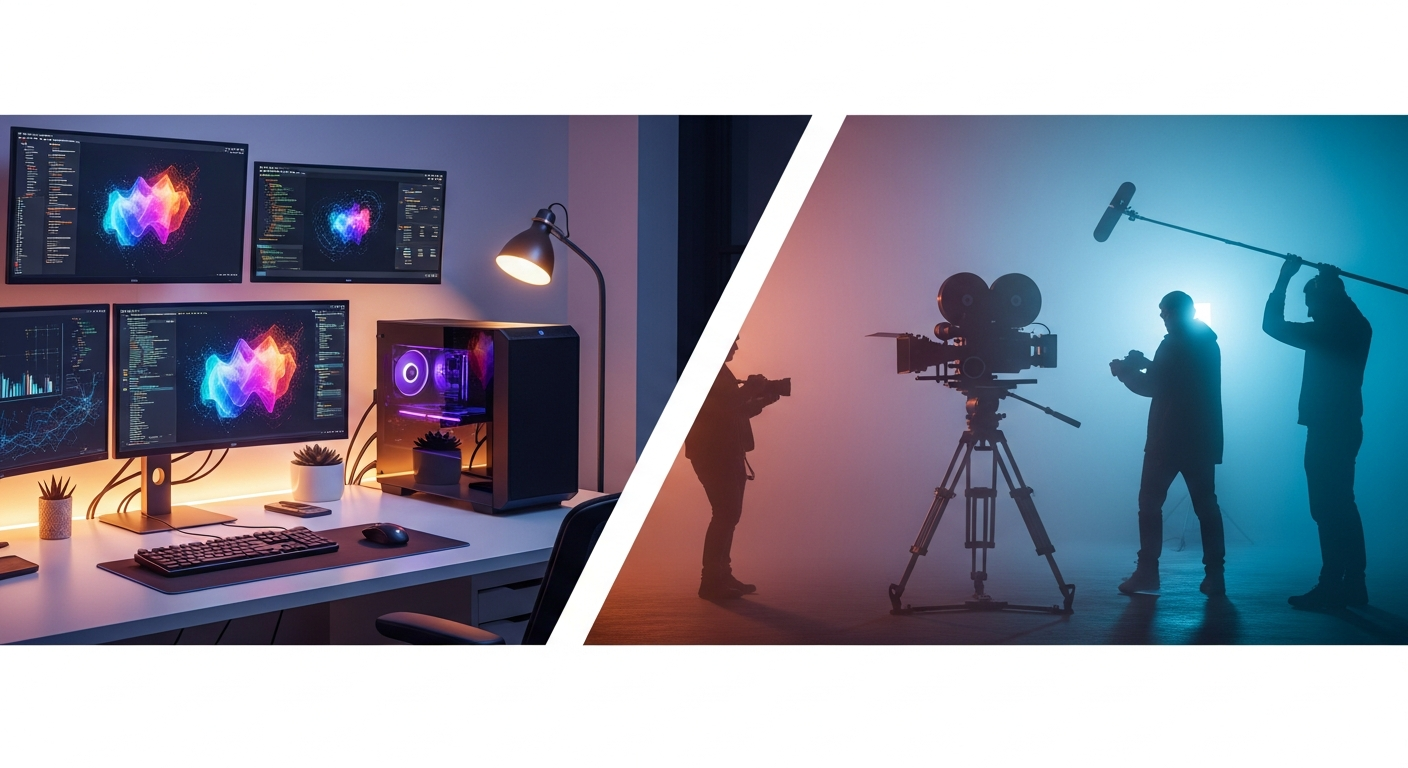
The choice between AI vs traditional video production isn’t binary in 2026. It’s a tradeoff across seven dimensions — cost, speed, quality, control, scale, risk, and craft — and the right answer depends on what you’re making, for whom, and at what scale. This guide is the side-by-side: a comparison table, the cases where each wins decisively, and a working decision framework you can apply to a real brief in under five minutes.
TL;DR — AI vs traditional
- AI wins on: cost (40–80% lower), speed (3× faster), scale (variants & languages), iteration speed.
- Traditional wins on: emotional storytelling, principal-photography craft, complex live action, controlled performances.
- Hybrid wins on most projects: live action for hero moments, AI for B-roll, finishing, variants, and dubbing.
- Decision rule: if the project needs volume + variation, go AI. If it needs emotion + a single hero output, lean traditional. Most briefs sit in the middle and want hybrid.
The 7-point comparison table
| Dimension | AI video production | Traditional production |
|---|---|---|
| 1 · Cost | $300 – $50K+ depending on scope | $3K – $200K+ for equivalent scope |
| 2 · Speed | 2 days – 4 weeks end-to-end | 2 – 12 weeks end-to-end |
| 3 · Quality bar | Broadcast-grade for most use cases; still imperfect on complex live action and emotional performance | Pixel-perfect quality with skilled crew; the upper ceiling for cinematic craft |
| 4 · Creative control | High at brief/script stage; some unpredictability during generation | Full control of every frame on a controlled shoot |
| 5 · Scale (variants & languages) | Excellent — 10+ variants and languages with marginal cost | Poor — every cut adds shoot-day or post cost |
| 6 · Risk profile | Regulatory (disclosure, deepfakes), generation failures, model drift | Weather, talent, location, schedule, equipment |
| 7 · Craft & emotional resonance | Adequate-to-good for most marketing; weaker for hero brand films | The bar — live performance, real locations, human moments |
For the broader context on how the AI pipeline works in 2026, see AI Video Production: The Complete 2026 Guide. The full cost breakdown is in AI Video Production Cost in 2026.
Where AI wins decisively
- Performance marketing & ad variants. When you need 30 cuts of a single concept across audiences, lengths, and aspect ratios, AI’s marginal-cost-of-variants advantage is decisive.
- Multilingual campaigns. AI dubbing and voice cloning across 10+ languages costs a fraction of traditional re-recording with native talent.
- SaaS & product explainers. Screen capture + AI narration + motion graphics is a near-perfect fit. Hiring a film crew to explain a piece of software is overkill.
- E-commerce product video at SKU scale. 200 product videos for a catalogue is impossible traditionally; templated AI workflows make it routine.
- Test & iterate fast. Weekly creative refreshes for paid social are economically only viable with AI.
Where traditional still wins
- Hero brand films. The anthem video that anchors a launch or a new identity benefits from real performances, real locations, and a director-driven shoot.
- Founder & documentary storytelling. When the story is a real person, generated content can’t substitute. AI assists in post but the interview is live.
- Complex live action. Sports, action sequences, stunts, large crowds, fluid dynamics — AI models still drift on these in 2026.
- Talent-led campaigns. A campaign built around a celebrity, athlete, or named expert needs traditional production (and explicit consent for any AI augmentation).
- Compliance-heavy regulated content. Some regulators still require human-witnessed production for political ads, financial disclosures, and pharmaceutical content.
The hybrid workflow — what most projects actually look like
The honest answer for most 2026 briefs isn’t AI or traditional. It’s both. A typical hybrid project:
- Live action: the hero shot — founder on camera, hero product in real lighting, the moment that has to feel human.
- AI-generated B-roll: connective tissue between hero shots, abstract metaphor footage, environment shots that don’t justify a location day.
- AI voice for VO: brand-voice clone or synthetic narrator for cost-effective consistency across cuts and languages.
- AI music: licensed original score generated to match the cut.
- AI finishing: rotoscoping, color grading, upscaling, captioning, dubbing into other languages.
- AI variants: aspect-ratio and length cuts derived automatically from the hero master.
Net effect: a hybrid project ships at ~50% of full traditional cost, in ~60% of the time, with the variants and languages a pure-traditional shoot can’t economically deliver — while preserving the emotional bar of a real performance.
A decision framework — pick the right approach in 5 minutes
Score your brief across these five questions. The total points you accumulate map to one of three recommendations.
- Volume needed. Single deliverable = 0 · 2–5 variants = 1 · 6+ variants = 2.
- Story focus. Abstract / product / process = 0 · Customer story = 1 · Named individual the hero = 2 (and reverse-weight: more points = lean traditional).
- Speed. 6+ weeks available = 0 · 2–4 weeks = 1 · <2 weeks = 2.
- Budget reality. $25K+ = 0 · $5K–$25K = 1 · <$5K = 2.
- Languages. 1 language = 0 · 2–3 = 1 · 4+ = 2.
Add questions 1, 3, 4, 5 (volume + speed + budget + languages — they all pull toward AI). Subtract question 2 (story focus pulls toward traditional). Then:
- Score ≥ 5: AI-first. Lean into AI for the full pipeline.
- Score 2–4: Hybrid. Live-action hero + AI for everything else.
- Score ≤ 1: Traditional-first. AI in post only, hero shoot is live.
Not sure which path your project needs?
Share your brief and we’ll quote both an AI-first and a hybrid approach side-by-side, with fixed pricing and turnaround for each.
FAQ — AI vs traditional video production
Is AI video production cheaper than traditional?
Yes — typically 40–80% cheaper for comparable output. Savings come from removing on-location shoots, smaller crews, and faster post-production. See the full pricing breakdown.
Can AI video replace a film crew?
For high-volume, short-form, and templated marketing video — yes. For hero brand films, founder stories, and complex live action — no. Most professional projects in 2026 are hybrid: AI handles 70–80% of the pipeline, traditional crew handles principal photography.
Which has better quality, AI or traditional video?
Traditional has a higher ceiling — the pixel-perfect cinematic bar. AI has a higher floor: it never has a bad-weather day, a missed flight, or a lighting mistake. For marketing video, the AI quality bar is now broadcast-grade. For Oscar-bait filmmaking, traditional still leads.
Is AI video faster than traditional?
Roughly 3× faster end-to-end. A 30-second spot that took 4 weeks traditionally ships in 1–2 weeks through an AI pipeline. Templated short-form shipping in 2–5 days is common.
When should I choose traditional over AI?
When the project depends on a real person’s performance, requires controlled live-action craft, has complex physical action AI models can’t yet handle, or is regulated such that human-witnessed production is required.
Do AI and traditional video look the same?
For abstract, motion-graphics, B-roll, and templated content — indistinguishable to most viewers. For tight close-ups of human faces, hands, and complex physical interactions — trained eyes can still tell. The gap is closing every quarter.