
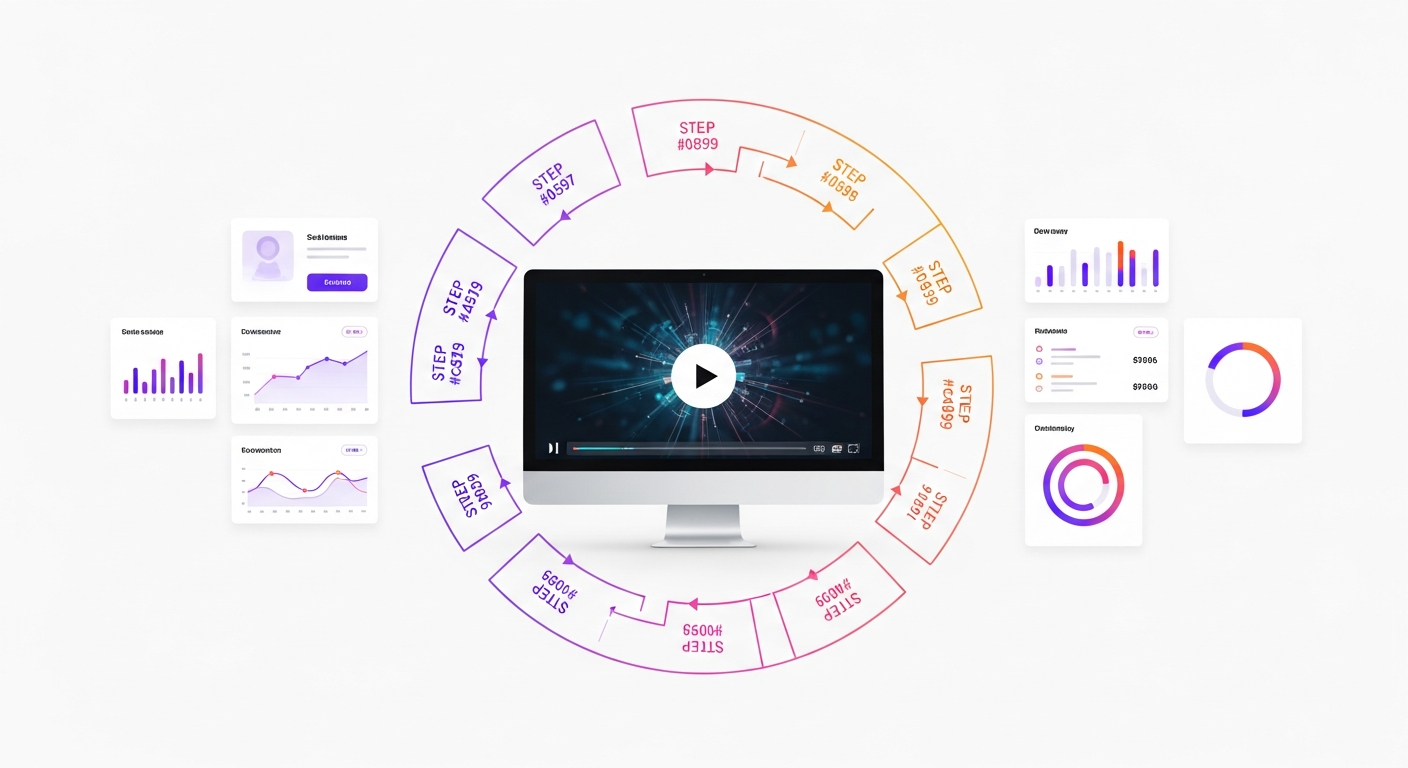
A good AI explainer video is the highest-ROI piece of content a SaaS team can ship in 2026. It runs on the homepage, lives at the top of every sales deck, sits in every nurture sequence, and gets repurposed into 30+ Reels and ad cuts. Done right, it lifts demo conversion 25–40% and shortens the sales cycle by weeks. Done wrong, it’s a generic narrator-over-screen-recording that the prospect skips at 4 seconds. This is the 9-step playbook serious SaaS teams use.
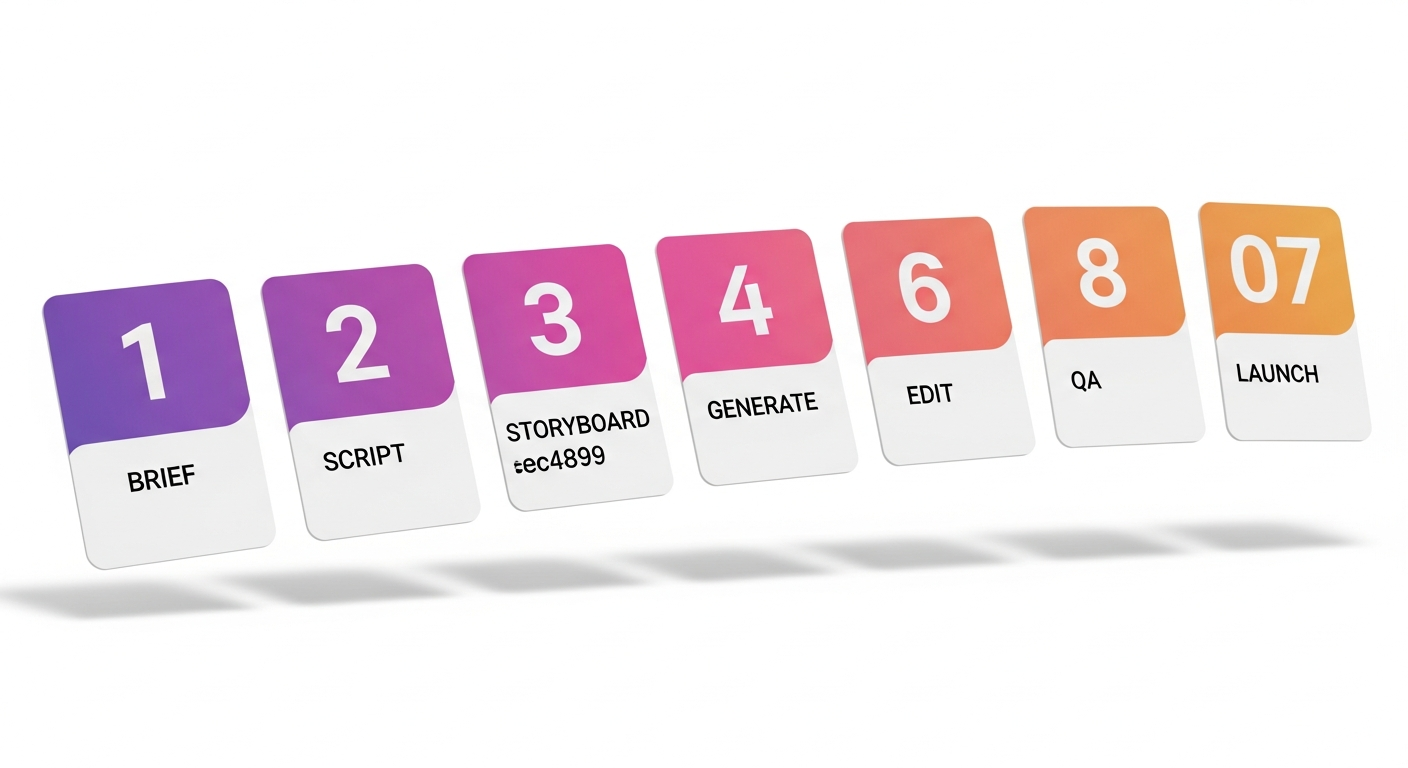
TL;DR — the 9-step playbook
- Pick the job-to-be-done and one buyer persona.
- Open on the problem, not the product.
- Use one of three proven script frameworks (PAS, AIDA, JTBD).
- Hold the video to 60–90 seconds.
- Show the product UI for ~30% of runtime — no more.
- End with a single, specific CTA.
- Ship a multi-cut launch pack: full, 30s, 15s, 6s, captioned, with founder VO option.
- Distribute across website hero, sales, email, ads, social, sales-enablement.
- Measure completion rate, demo-CTA click-through, demo-conversion delta.
Why SaaS explainers are an outsized lever
An explainer video is the only content asset that scales across every motion: marketing (homepage), sales (decks & emails), customer success (onboarding), and recruitment (employer brand). For SaaS specifically, three things compound:
- Product complexity shrinks. A great explainer makes a complex product feel obvious — and obvious products convert.
- Sales cycles compress. Prospects who watch a good explainer arrive at first call already qualified on category and problem fit.
- Trust is borrowed forward. The video shows you can communicate clearly — a strong proxy for whether the product itself will be clear.
The 2026 unlock is that all of the above used to require a $20K–$60K production. With AI, the same quality bar lands at $3K–$12K — covered in detail in AI Video Production Cost in 2026.
Step 1 — Pick the job-to-be-done and one persona
Most SaaS explainers fail because they try to speak to every buyer about every feature. A working explainer picks one persona and one job they’re hiring software to do. That’s the brief.
Bad opening: “Our platform helps companies streamline operations across teams.” Good opening: “When the product launch slips because the legal review took six days, the marketing team finds out on Slack at 11pm on a Sunday.”
Step 2 — Open on the problem, not the product
The first 5 seconds decide whether someone watches the next 55. Open with the painful, specific, recognizable moment — not the brand name, not the logo, not the product UI. If the viewer is in your ICP, they should think “that’s me” before you’ve said what you sell.
Step 3 — Pick a proven script framework
PAS — Problem · Agitate · Solution
Set up the pain → twist the knife → reveal the fix. Best for sharp single-problem categories (security, compliance, customer support).
AIDA — Attention · Interest · Desire · Action
Hook → expand the world → show transformation → ask. Best for broader categories and platforms.
JTBD — Situation · Motivation · Outcome
Show the specific situation → reveal what they really want → demonstrate the outcome. Best for nuanced B2B sales where the buyer hires software for an outcome, not a feature.
Step 4 — 60–90 seconds, no exceptions
The sweet spot is 75 seconds. Under 60 and you can’t earn trust. Over 90 and completion rates drop off a cliff. We measure this across hundreds of explainer projects: median completion at 60s = 78%, at 90s = 64%, at 120s = 41%. The arithmetic is simple: a tighter video, watched fully, beats a longer one, half-watched.
Step 5 — Show the product for ~30% of runtime
This is the single number most SaaS teams get wrong. They want to show the product for 80% of the runtime. The right number is around 30%. The rest of the time is on the buyer’s world, the problem, the metaphor, and the outcome.
Use AI-generated B-roll for the non-product 70%. Generated office shots, abstract environments, problem-space metaphor footage — this is exactly where AI video shines and where a traditional shoot would blow the budget.
Step 6 — One CTA, specific and time-bound
Bad: “Learn more.” Better: “Book a demo.” Best: “Book a 20-minute call this week — we’ll show you the launch-tracking dashboard in your own data.”
Pick one. Don’t list three. The video that asks for one specific action outperforms the video that gives the viewer a menu.
Step 7 — Ship a multi-cut launch pack
The 75-second master is the start, not the deliverable. Each launch ships with:
- 75s master (homepage, sales deck, email)
- 30s cut (paid social, sales follow-up)
- 15s cut (top-of-funnel ads)
- 6s hook (pre-roll, retargeting)
- Vertical 9:16 (LinkedIn video posts, Reels, Shorts)
- Square 1:1 (LinkedIn feed, Meta feed)
- Captioned versions (sound-off feed, accessibility)
- Founder-VO alt (optional, for warmer outreach)
AI workflows generate these from one approved master at marginal cost — the entire reason explainers became economical in 2026.
Step 8 — Distribute everywhere
| Surface | Cut | Why it works |
|---|---|---|
| Website hero | 75s muted with captions, autoplay | Lifts demo-CTA click 25–40% |
| Sales deck slide 1 | 75s | Aligns the buyer on what you do in <90 seconds |
| Cold email | 15s GIF preview → click to 75s | 3× reply rate vs text-only |
| LinkedIn organic | 30s square, captioned | Founder-VO version drives engagement |
| Meta & LinkedIn ads | 6s + 15s | Hook variants for CPM optimization |
| Sales enablement | 75s | SDR & AE training; demo prep for prospects |
| Onboarding | 75s | New customers re-watch on day 1 |
Step 9 — Measure the three metrics that matter
- Completion rate. What % of viewers watch ≥75%? Target > 60% for the master.
- CTA click-through. Of completers, what % click “Book demo”? Target > 15%.
- Demo-conversion delta. Does the demo book-to-close rate move when the prospect watched the explainer beforehand? This is the real ROI number.
Need a SaaS explainer that lifts demo bookings?
We ship the 9-step playbook as a fixed-scope project. 75s master + full multi-cut launch pack, 2–3 weeks from brief to delivery, transparent pricing.
FAQ — AI explainer videos for SaaS
How long should a SaaS explainer video be?
60–90 seconds for the master. Median completion at 60s is ~78%; at 120s it drops to ~41%. Shorter, fully-watched videos outperform longer, half-watched ones across every funnel metric.
How much does an AI explainer video cost for SaaS?
A bespoke 60–90 second AI explainer typically runs $3,000–$12,000 including script, AI generation, voiceover, music, motion graphics, and a multi-cut launch pack. See the full pricing breakdown.
Should the explainer show the product UI?
Yes — for about 30% of runtime. The rest should be on the buyer’s world, the problem, and the outcome. Showing UI for 80% of the runtime is the most common SaaS explainer mistake.
What script framework works best for SaaS explainers?
PAS (Problem-Agitate-Solution) for sharp single-problem categories like security or compliance. JTBD (Situation-Motivation-Outcome) for nuanced B2B sales. AIDA for broader platforms. Pick one and follow it — don’t blend three.
Where should I host my SaaS explainer?
Self-host via Mux, Wistia, or Vidyard for the homepage and sales surfaces (lets you measure completion and pixel ad audiences). Mirror on YouTube for SEO and discoverability. Avoid embedding only from YouTube on your homepage — you lose attribution and analytics.
How long does it take to make a SaaS explainer with AI?
2–3 weeks from brief to delivery of the multi-cut launch pack. The brief and script stage takes the longest — generation, edit, and finishing fit inside the back half.
Can I use AI voice instead of human VO?
For most SaaS audiences in 2026 — yes, AI voice is indistinguishable from human VO at explainer length. Use a brand-voice clone for consistency across cuts and languages. For founder-led storytelling, use the founder’s real voice (or a consented clone of it).